The good thing about summer is that it gives me a chance to catch-up.
I’ve spent a lot of time updating data, reports and upgrading the training decks.
One of these areas I thought I’d share with you is optimum lengths for short-form video.
On the face of it, here’s not really been much change over the last.
But digging into it, yes there has.
For optimum video lengths, keep it short and simple.
So much is in and around the 30-second mark. That’s the case with Reels on Instagram and Facebook as well as X and LinkedIn.
LinkedIn sometimes surprises people. Only 30-seconds? But remember, you are chasing busy professional people who are time poor.
How these figures can be helpful
The job of a comms person is to educate the client in a rapidly changing landscape. Having these stats should help you bat away a request for an eight-minute clip of a middle manager talking about an arcane project only he or she cares about.
Like the Schleswig Holstein question, only three people ever understood it and one of those became insane.
Why optimum lengths don’t matter so much
When digging into the research it’s clear that the algorithm isn’t chasing a pre-appointed length and pushing those.
There is no magic length number.
What matters most of all is retention. How many people stick around?
So, make a longer film if you need to but you need to deliver something of value.
A three-minute TikTok that retains 50 percent of people is classed as ‘good’.
Retention rates for short-form video
The idea of retention being important means there’s no a post-posting phase for the video. You posted it. But how is the clip performing?
Go back into the data and see where people switched off. What was it? A person? A lack of cutaway? The subject?
Bring that forward for the next film you make.
There’s upcoming dates in Birmingham, London and Edinburgh as well as online. I can also come to you to deliver training to you and your team.
It’s clear that Andy Burnham’s use of TikTok has blown open the door for many public sector organisations.
Engaging, topical sometimes talked about policy and sometimes didn’t the approach was a key part of the Prime Minister’s honeymoon period.
Other politicians are available, but if 10 Downing Street is using it, what excuse do the rest of the public sector have?
Quick note: TikTok has never been banned in the UK. UK Government advice which devolved governments also share is not to have TokTok on a device which has your work email. The workaround to this? Edit and post your TikToks from a burner phone.
If you’re worried you’ve missed the boat, are too old or don’t have the aura (ask your children) then I’ve gone through the TikTok advice and read the data so you don’t have to.
Before you get started with TikTok
Spend a month with the app. Seriously, spend some time getting to know and understand it. The algorithm is based on your what you are interested in not your friends. So, if you like midweek recipes then by doing things like watching all the way through, liking and forwarding to a mate you’re telling the algorithm that you’ve enjoyed that. So, the algorithm will send you more.
Realise that TikTok is not marketing, public relations or even traditional social media. It needs a different approach. As TikTok say themselves:
“TikTok is not a social media platform. It’s an entertainment platform. People aren’t scrolling to be sold to. People come to laugh, learn and then switch off.”
Now, we can argue the legal definitions. But the broad point is not to think sell, sell, sell. There’s time for that. So, an account that is all wall-to-wall call to action will hit a low ceiling.
The account that has some non-selling content works better.
Your first second is critical. You need to get people’s attention and watching. You’ll notice this the more time you spend. This is critically important.
Get started as a public sector TikTok account
Make sure you have a business account. Here’s a short TikTok on how to do that with your existing account. You’ll be limited to what TikTok’s assets you can use when you edit within the app using this route. That’s things like music. You’ll have less choice but this means you won’t have a tap on the shoulder from a music publisher demanding money after that viral campaign used their track.
Make your bio relevant. If you are a museum in the Black Country then tell people and give an address and a postcode. Make it relevant.
You and your chief executive aren’t the audience. If you are going down a TikTok path you may be doing so to reach a younger audience. Your chief executive may neither like or understand the content. They are not the audience. If you only communicated on the channels he or she liked it may be the BBC, Local Government Chronicle and The Angling Times. That is not a media landscape. That’s a chief exec’s niche.
Be ready to experiment. TikTok is a platform that’s evolving and changing. Having business account opens up some extra analytics.
TikTok hates polish. Rough edges are fine.
Planning your TikTok
Shoot vertical. TikTok is a vertical app.
Ask yourself the question: ‘What does the viewer get out of this?’ What’s in it for them? Are you telling people where to go in your area at half-term for low or no cost? Are you telling families how to prepare for flu-season? Or what fire safety advice a fresher needs to know going away to University for the first time?
Think about what they NOT the organisation wants.
The audience wants to see themselves reflected. The keen walker wants to see a keen walker talking about why the Yorkshire Dales are great in the Yorkshire Dales themselves. They want that connection with the person.
Come up with a shot list. You need the fresher outside their student house, the smoke alarm and the points you want to cover.
Script or not script. TikTok says people like authentic videos, authentic people and realism. That doesn’t always lend itself to scripts. But for the public sector, there’s some great scripted local government examples. Why does this work? It keeps the cabinet member on track. You don’t get 30 seconds of what happened at scrutiny committee which is of interest to literally six people.
While we’re at it, don’t waste your time on names at the start of your TikTok.
“Hello, I’m Cllr Dan Slee, cabinet member for regeneration services….” is death. Put their title on the screen not in their mouths. The first second is critical, remember?
Hooks, hooks, hooks, hooks. Hooks are the text at the start that clip that you hope reel in people’s attention. As an ex-journo, I think of them as the placard outside the newsagent shop to lure people in to buy the paper. TikTok’s advice is:
Problem + curiosity = a good hook.
So,
Need half-term activities in Dudley? Here’s some you may not know.
The problem is half term is coming and parents are wondering how to keep their children entertained. The curiosity is places you may not know.
Evergreen adds life. Some content needs to be topical. Others can be evergreen and can be resurfaced by the algorithm at a future date.
If you have a campaign make multiple videos. One TikTok won’t rule them all. But several will drop in front of people and remind them.
Don’t overload. If there are five brilliant things about the national park, maybe make five short TikToks rather than overloaded one.
If there is a call to action, make it clear. Tell them to click the link for the download of family-friendly walks.
TikTok Creator Insights. This is a webpage that shows you whats popular on TikTok that you can use for inspiration or ideas. That trend could sometimes be adapted for the museum.
Editing your TikTok outside the TikTok app
Edit outside and finish off on TikTok. Personally, I’m a fan of editing outside the app and then finishing off using the app itself. Why? TikTok’s editing app Capcut is really good in many ways but it won’t let you add cutaways. For me, that’s a stumbling block. Cutaways are the supporting clips that add colour. So, if the interviewee is talking about how beautiful the daffodils are in the park in Springtime you can add some footage or an image of those blooms.
Besides, you may want a short form video on Reels or LinkedIn, too. If you edit outside the app you can use that edit across several platforms.
Keep the top 20 per cent and bottom third of the screen free. The platform will add a caption in those areas. So, be careful.
Then finish off on the TikTok app
If you first edit outside the app, upload it and finish off in TikTok. If you’ve a business account you’ll be limited to audio cleared for business use that you can add a this stage. This is good for the reasons already covered.
Job title as a title on screen. I’ve mentioned this before but it needs repeating. People don’t want to waste time on their title.
Date stamp on the app. The BBC do this and I’m quite a fan. Put the date in a corner of the video. This is particularly useful on a fast-moving crisis. So, the fire that has closed off the motorway? Put the date on. It may not drop into people’s timelines for a week. Build in obsolescence in those circumstances.
Work out your key words. If you are launching a first aid course for new parents in Aberdeen include this in the words the speaker says and subtitle using TikTok’s app. This way the script becomes metadata. Metadata is the clues search engine look for. On a webpage, this is the page title, sub-headers, the text itself as well as pictures or video. TikTok’s metadata is the speech it can subtitle, the title, hashtags and the caption.
Add a geotag in the editor on the app. If you are in Powys, add a Powys location. This means you’ll reach more people interested in Powys.
Don’t go overboard on the hashtags. Too many confuses people and it’s the reason why people don’t break past 200 views. Oh, and the #fyp – for you page – hashtag is buried below eight billion clips. TikTok’s advice is go niche.
Don’t use the word ’viral’ TikTok say. Everything is viral.
Posting your public sector TikTok
There isnt a single best time to post. This isn’t me saying this, this is TikTok.
Your TikTok will be shown to 200 people. If it works with them it’ll go to more people. This is why the key words are so important. The more clear you are the more chance of reaching the right people.
How do you know if your TikTok has worked?
As a metric, retention, retention, retention. TikTok really stress the importance of retention over all other metrics as the thing to strive for. Retention for them beats everything. So, a 45-second clip watched by 50 per cent all the way through is more valuable to the algorithm than a 180-second clip watched all the way through by one per cent. This is the metric to look at.
Your engagement graph. Each clip will show how many people watched and when they drifted away. A 30-second clip watched by 50 per cent is good. Don’t skip this. Go back and see what worked.
Did they do what you wanted? Did people go to the park at half term? Or sign-up for the special event at the gallery?
Don’t be frightened to experiment. Every time you post you’ll learn something.
Post-posting
Once you’ve posted, go and engage. Keep an eye on comments and reply to them where you can. TikTok likes the idea of a community and you talking to them. Comments can also be a jumping off point for your next content and TikTok really likes that. If you are just talking about yourself that’s not so good. Talk about your community, too.
That’s a snapshot.
There’s more at the training I offer.
There’s upcoming dates in Birmingham, London and Edinburgh as well as online. I can also come to you to deliver training to you and your team.
Blog chums, a post to say I’m running a series of actual live-in-a-room training events and I’d love you to come along.
They’ll be in three locations and I’m hugely looking forward to them.
Why in-person? Because in 2026 I’ve noticed that there’s a powerful thirst for people coming together in a room. Lockdown is a memory but the working practices it created are often still with us. We’re rarely in the office all together. We spend a lot of time on Teams calls.
So, I thought I’d turn the clock back and run three ESSENTIAL VIDEO SKILLS REBOOTED workshops at locations.
EDINBURGH 15.10.26 LONDON 22.10.26 BIRMINGHAM 6.11.26
The day will run from 9.30am for a 10am start, we’ll break for lunch and then wrap up by 4.30pm. Lunch, tea and coffee will be provided.
In the coming months, I’ll run other dates and workshops.
For more information and how to book head to the workshop page.
Who is this for?
This is for someone with lots or no experience who is looking to understand the strategy needed for video and also get their hands on with editing. You may be making lots of video or none at all but you need to understand it. It’s aimed at the public sector but if you’re housing or third sector you’ll get something from it, too.
It’s aimed at heads of comms, managers and officers.
What will we cover?
On the day, we’ll plan, shoot and edit using a smartphone.
We’ll look at the big picture of where video sits, how to get the most out of your device, sound, composition, optimum length, editing skills and posting on Reels, YouTube, TikTok and LinkedIn.
Why do it?
Because 50 per cent of time spent on Facebook is spent watching video, Meta says. All of the platforms are incorporating more video. If you want to be an effective communicator you need to know about video.
Because people who have done this course have developed new skills, won awards and gone onto better jobs.
And also, as Robin Williams once said, because being in the same room as people and creating something is a good thing.
Are you still running online sessions?
Yes, absolutely. There’s dates on the workshop page here.
Can you come to us and deliver for the whole team?
Yes, absolutely. Drop me a note via the form below.
Who has been on the training before?
This ever-updated course was the first more than a decade ago to offer bespoke training for comms people.
Clients have included the BBC, McDonalds, UK Government, Scottish Government, Orkney Council, NHS Sandwell & West Birmingham NHS Trust, Manchester City Council, Pembrokeshire National Park Authority, South Wales Police, Staffordshire Police, Devon & Somerset Fire & Rescue, London Fire Brigade, Greater Manchester Mental Health NHS Trust, University of Durham, University of Aberdeen, University of Manchester, College Gwent, Wigan Council, Gwynedd Council, Sanctuary Housing, Yorkshire Housing, Link Housing and Metropolitan Police.
Hey everyone, there’s some new guidelines for AI content you need to know about.
But I’m really busy, Dan.
I know. That’s why I’ve blogged this walk through for you.
But I hate AI.
I know. That’s why I’ve blogged this walk through for you even though I know only a small number will read this compared to posts I write about tactics. But those small number by staying up to speed will likely still have a job in years to come. But I’m not going to persuade you.
Go on then.
It’s from the EU. Remember them? They’ve published an AI Act. They’ve published some guidance on Article 50 which requires which requires people to mark some of the content which has been made with the help of AI. They’ve even written it in English.
The EU? Haven’t you heard? We’ve taken back control. We’re not in the EU anymore.
I know. But this applies if that content has been aimed at people in the EU.
Cool. I don’t need to bother, then.
That’s fine. But actually, what they are setting out is a useful yardstick to maintain confidence in your content at a time when people are getting increasingly restless about AI. In 2023, The Alan Turing Institute ran some data that showed 72 per cent were in favour of strong Government regulation of AI.
They do. But rather than one set they’ve left it to different watchdogs. So, if AI is used to create an ad that looks misleading the Advertising Standards Agency can use existing powers.
Alright then, what does this EU guidance say?
Basically…
If it’s deepfake it needs to be marked as AI.
If text has been made by AI but has been edited by a human it doesn’t need to be.
If AI has been used for things like noise-cancelling or subtitle creation this is ‘standard editing’ and doesn’t have top be marked as AI.
If you are using a tool, make sure it complies with the EU AI act by adding machine-readable markers that allow for detection. No, the EU haven’t published a list yet. Which is a bit annoying.
If you are getting your head around AI this guidance is really sensible.
For more, I deliver training to help you make sense of the changing landscape.
There’s been a slew of posts about new Prime Minister Andy Burnham’s use of social media as a communications channel.
There’s been some interesting reads. He’s recruiting a dozen more social media posts for the 10 Downing Street operation. He may or may not be the UK’s first social media Prime Minister.
Let’s been honest, two weeks in and he’s on his honeymoon period.
But there’s enough there to intrigue me into making me spend some time evaluating his content.
I’m anticipating the training request ‘we’ve been asked to make our senior people look as good as Andy Burnham.’
How politicians used to communicate
Growing up, the set-piece TV interview was the way politicians would communicate their thoughts and policy detail. Journalist Rob Burley’s excellent ‘Why Is This Lying Bastard Lying To Me’ traces the rise and fall of the 40-minute Sunday morning political interview.
The trouble is nobody outside Westminster wants to watch.
So, with more than 80 per cent of the UK population having a social media account it makes sense to be good these channels as well as media relations, strategy, policy, public speaking and all the other things a successful Prime Minister needs. For a Labour politician facing a hostile media it also makes sense.
Were I still in regional media, I’d be asking why local news journalists don’t get to interview the Prime Minister so much when he visits town. And yes, other politicians are available.
So a post of three parts. First some data then some learning points and then some content.
PART 1: Some data on Andy Burnham’s social media content
So, how are the numbers? I’ve taken a look at Andy Burnham’s own Instagram, TikTok and Facebook. I’ve not looked at the 10 Downing Street accounts.
At first, I looked at Instagram mapped content there. But exploring TikTok and Facebook it was clear there was content unique to those platforms. How come I haven’t looked at X? Hours in the day, mainly. X is still important to politicians and journalists but less so for the wider public. A quick glance over there shows much less engagement but strong reach. So, around 13,000 engagements on X for the two week and here’s what we’ve achieved listicle. That’s about half of the performance of the same content on Instagram.
I looked at engagements per post as a metric. Why? Because likes, comments and shares are a marker of people literally engaging of what is being said. They haven’t simply scrolled past. When people engage it also sends a signal to the algorithm to show it to more people. Not only that but they are more likely to be shown future content.
Instagram is his largest channel with 660,000 followers outranking Facebook (610,000) and TikTok (465,000). But follower numbers are less important. All of the platforms are showing you content from people you don’t follow if it performs well or you’ve shown an interest in related content.
I’ve also calculated the percentage reach for each of the channels. So, in other words, if you have an account with 100,000 followers reaching 5,000 would be five per cent. It’s a marker of how effective the content is.
But its TikTok with a 16.6 per cent engagement rate that’s the real winner. That’s more than ten times the social platform’s suggested 1.5 per cent benchmark. That would be of interest no doubt to political pollsters.
The overall raw numbers pan out in a very similar shape for overall engagement numbers. On average, the 77,000 engagements for TikTok outrank the 25,000 engagements on Facebook and 21,000 on Instagram.
Part 2: What you can learn from Andy Burnham’s social media strategy
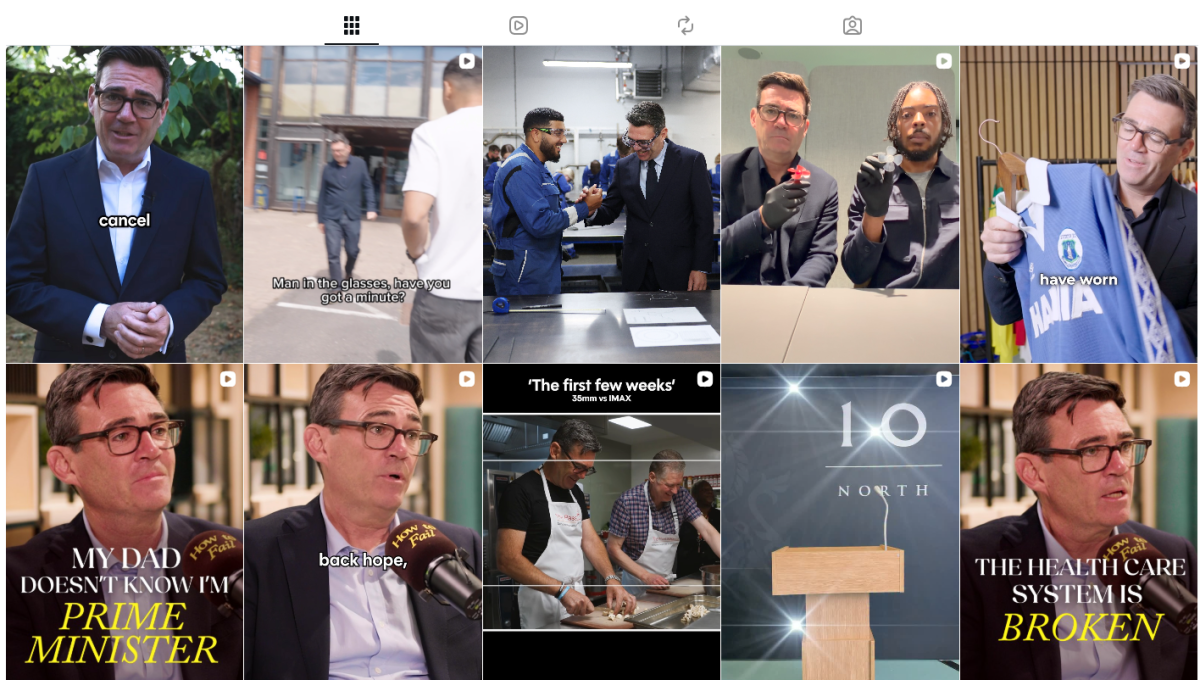
Collaborations, collaborations, collaborations. His team love to set him up with a collab. That’s working with an interviewee for a chat with content often being shared. Of the 25 posts, seven are collaborations. This works here to show a very human side. 4
He sits down with Elizabeth Day from the ‘How to Fail’ podcast which elicits an emotional moment where Andy Burnham reveals how his Dad’s Alzheimer’s disease is so advanced he doesn’t realise his son has been made Prime Minister. Imagine your crowning glory being taken away from you, you are invited to wonder. It’s a touching moment that probably wouldn’t work with a political interviewer. It reaches 100,000 engagements on Burnham’s Instagram but isn’t posted to TikTok or Facebook by his team.
Instead, the ‘How to Fail’ channel is where you can find it on TikTok and Instagram along with eight other clips and a 54-minute podcast on Spotify and other providers. That’s the nature of collaborations.
He also meets @classicfootyshirts to talk about his love of Everton FC as well as the more heavyweight former diplomat Alexander Dragonetti. There’s also street voxpopper @robcolfer which allows him to talk about Sheffield music and science influencer Big Manny which has more than 100,000 engagements across Instagram and TikTok.
The basic sums of this is that he can break out of his own channel and reach other audiences who probably aren’t following much hardcore politics. It’s a smart move as part of a wider strategy. Critics may say this is not rigorous feet to the fire scrutiny.
Working with influencers will probably work in a honeymoon period. In times of crisis I’d expect this will probably be left in the toolbox.
Influencers. Yes, the public sector can work with influencers. But a bit of prep is needed to make sure you are not sitting down with a dark past or shady opinions.
It’s not posted across all channels. This is such an important lesson from this exercise. Content is posted to the platform where it’ll work best. So, stop the boats is reserved for Facebook. Posts about training for young people go to TikTok. That makes sense. Be aware of the channel.
Bespoke content. Sometimes there was Instagram-only, TikTok-only and Facebook-only content. I was surprised to see Andy Burnham’s admins experiment with text-only posts on Facebook which are also quite long form. Several hundred words on a topic is perhaps surprising.
Softer content gets the audience for the drier policy stuff.. This is not the best performing content but posts which set out what the PM has done that week. They feel like the meat and potatoes. They want you to know this. My guess is that softer content reels people in to create a bigger crowd for the more serious messages.
Video, video, video. There’s so much video. To someone who has been banging on about the importance of video this gladdens my heart. But it is not a cure all. There are times when it’ll work and times when it won’t.
Not so much traditional politician content. The collabs by definition break outside of the politician at the Despatch Box or lectern. In fact, it’s notable how little traditional PMQs sound bite or lectern content there is. Why would he? He’s about doing things differently.
To camera and in conversation. Burnham sometimes delivers a piece to camera and sometimes is captured chatting to an interviewee. That feels deliberate. Mixing it up freshens it up and will deliver different results. The piece to camera can be the points he wants you to know. Counter intuitively, the conversations with interviewers reveal the most personal and intimate content. Revealing the point about his Dad’s dementia may feel a little too manipulative if it was in a speech.
Hope. One of his early positions is the aim to restore a sense of hope. Indeed, there’s a video which captures this. So much of the internet can be powered by rage and there’s an absence of angry finger pointing here. In this snapshot of content he doesn’t mention his political enemies by name. They’re not even in the screen. His team would probably argue that the content reflects the hope message.
Speaking off the cuff. As an experienced politician he makes a lot of what he says look effortless. He has an ability to communicate without notes. This is rare. Warning: most politicians trying to emulate this will struggle. He has a well thought-out message and he delivers it in conversation rather than set piece soundbite from an autocue. There is no Tony Blair-style jarring of ‘This is no time for soundbites… but I feel the hand of history on my shoulder.’
All this will make it difficult for other politicians to replicate. The bright comms team will anticipate this. The more tightly scripted and tightly edited Oxford City Council approach feels a better route for the less experienced performer.
Part three: the content itself
Dive in, have a look. It’ll change with time and events no doubt
VIDEO:I’m back down at Ashton Bears. A selfie video shot in landscape in downtime revisioting the Rugby League club he visited during the recent by-election.
Instagram engagements: not posted
TikTok engagements: not posted
Facebook engagements: 9,200
Video length: 1 minute 42 seconds.
VIDEO:AI is important so is engineering. A video direct to camera in hi-vis celebrating engineering and other jobs. This is related to the policy announcement also in this run about practical jobs being important.
VIDEO:Ask me anything. Taking questions posted on a range of subjects some tricky and some not. While one shot with captions, it is made visually more interesting by jump cuts that crop in on each closer creating pace and intimacy. This plugs into the internet convention ‘ask me anything’ when famous people take questions from the public.
Likely to appeal to: A scrolling audience.
Hook: ‘Ask me anything’.
Instagram engagements: 5,900.
TikTok engagement: 21,300
Facebook engagements: 10,900
Video length: 1 minute 30 seconds.
VIDEO:Collaboration with @ellisplatten(138,000 followers) the man who owns classicfiootballshirts. Ellis uses the Number 10 podium to joke how his first policy would be to make everyone wear a football shirt.
VIDEO:It shouldn’t just be about University education. This is shot with an off-screen interviewer the PM is engaged with. It covers a significant policy change. Young people should be encouraged that vocational education is a good route foir their career.
Likely to appeal to: Parents and young people.
Hook: “For too long, young people have been told there’s only one route to success.”
VIDEO:The need to devolve power. A piece to camera celebrating the regional differences of a roll / barm / tea cake / cob to make the point that local people know what’s to be done locally.
Likely to appeal to: People from the Midlands and North.
Hook: Now this is a barm and no-one can tell me any different.
In July 2026, more than 600 people who live in Nethy Bridge in the Scottish highlands were advised to leave their homes as wildfire threatened their homes.
This was a hugely significant fire which came after weeks of baking temperatures.
The fire and the escalation of the support was a thing of controversy.
But how was the news communicated? I looked at a three day period from July 24.
Breaking it down into basic terms, there is a mixed footprint.
There will be, I’m sure, after-the-event reviews of the event which will also look at the communications. This will no doubt far more detailed than this blog.
But looking at a snapshot some points emerge.
Much of the fire, police and national park content was datestamped. This builds in obsolescence and prevents the algorithm serving something five days down the track without the consumer understanding this is dated.
X was largely ignored by the public sector. Highland Council posted eight times but on average received seven engagements. Scottish Fire & Rescue never posted to the channel while Cairngorms National Park Authority’s account is dormant. The 50 tweets surfaced on the search term ‘Cairngorms’ focussed on the politics and conspiracy theories.
Facebook was where the engagement was. Content performed strongly on this platform. On average a Scottish Fire & Rescue post received more than 3,600 engagements while the Cairngorms National Park received more than 3,100 likes, comments and shares.
Switching off Facebook comments may have affected reach. Highland Council stopped anyone commenting to their updates and saw their engagements notably lower. It’s possible that a time of crisis people may have wanted to ask a question or tag in a friend or family member. Then again, Highland Council were playing a supporting role in the incident.
Scottish public sector has not embraced TikTok but the public have. The Herald, Sky News, BBC News, Inverness Courier and other journalism sources provided rolling content. Twelve of the top 50 TikToks on July 27 were from news sources. Others were posted from influencers and other news aggregators.
In a crisis, helpful information works. In other times, creative solutions are needed to attract an audience. In a crisis, basic timely information attracts an audience.
Turbulance is everywhere in the public sector right now.
A casino wheel is spinning and it’s uncertain how that’s going to land in large parts of local government, NHS and police.
The uncertainty doesn’t end with the announcement, either. That can be the start of it.
Now, strategically all this is an opportunity. A head of comms can start again with a blank piece of paper and design something really fit for purpose. That’s exciting if you are up for change.
But how does that feel to the individual?
“Not great, Bob,” as the meme says.
The skills we need
Earlier this year, I wrote 77 skills a comms team needs to have. You can read that here.
That can be useful to the head of comms but reflecting on it this week, what lessons can that teach an individual?
In plain terms, the list shows that no individual can master all these skills. But there are core skills you can have.
As an individual, get your core skills polished. Learn new skills. But above all think of what you are doing as solving problems. You don’t look after Facebook, you communicate with an audience of over 30s online.
Look, I know that seems a bit LinkedIn but Facebook pages are the tactic while reaching that audience can help bring results and thats where you need to be.
In the words of George Harrison, all things must pass.
For more, I deliver training to help you make sense of the changing landscape.
One part of my brain thinks ‘about time’ while the other is just glad they are finally using tools that can effectively reach audiences.
So, with that in mind, I’ve written a Blue Peter-style summary to help bring you up to speed.
If you’ve not been using it here’s what you need to know.
No, I don’t think you should be on it just for the sake of it.
Yes, I do if you want to communicate with younger people.
TikTok was never banned
I know surprising, isn’t it? But it was never banned. The advice from UK Government and devolved governments was not to put TikTok onto a device which also had work emails. A trip to Argos to buy a burner phone would have enabled the organisation to carry on safely within the advice.
More than a few people I’ve spoken to either didn’t know the full guidance or used it as an excuse.
For me, if you don’t want to use it for strategic or capacity reasons that’s no problem. So long as you are clear what your strategy or capacity exactly is.
Your public sector TikTok strategy
Your chief executive may not like TikTok… they are not the audience. There’s a degree of snobbery and misunderstanding about TikTok from people who don’t use it. No, it’s not all dancing nurses.
It’s not just young people. What began as something for under 24s has broken out to older users. Almost eight in ten of under 24-year-olds use TikTok. That’s expected. But the figure is around half of people in their early forties. Surprised?
TikTok is a video-first platform. You switch it on and you are delivered video straight away.
It’s about your interests not your connections. Twitter, Facebook and the other social media channels started off by serving content into your timeline from people you follow. TikTok turned this on its head and serve you instead based on your interests. So, if you spend time watching midweek recipe ideas on TikTok then the platform algorithm works out thats what you are interested in so will give you more.
This curated feed lands on the For You Page (FYP). More than 90 per cent of video watched on TikTok is this rather than the ‘friends’ or ‘following’ options.
Entertainment. People go to TikTok to be entertained. If you can slip in some health advice on the way you are winning.
Common TikTok mistakes
Just whack onto TikTok what you’ve already done for other platforms. I’ve seen this done. It never works. To borrow a line from the video platform, ‘Don’t make an ad, make a TikTok.’ Make something that’s going to work.
Hello, my name is. The ‘my name is’ NHS bedside routine introduces the patient to the medical professional. Avoid this on TikTok. You have barely more than a second to hook people into watch your video. Don’t blow it with a name. Add the name and job title as a title on the screen.
Thinking its too hard. TikTok will take time but you don’t have to block out three days a week to make the platform work.
Thinking you don’t have the content. You probably do. But people won’t automatically find what happened at finance and audit scrutiny committee interesting.
Seeking sign-off for here today and gone tomorrow trends. A trend is a video that has worked for someone and people would like to replicate.
Hot topics will get a response. CAHMS, the part of the NHS that looks after teenage mental health, made a gentle TikTok with a nurse. This turned into a reaction video from a deeply unhappy service user. The original CAHMS post had allowed a re-use of the original when it was uploaded. This can be unchecked to make it harder.
Common ways to win on TikTok
The first second matters. A text hook on the screen should tease and tantalise. You have a second to make an impact before the scroller scrolls.
Look for inspiration on TikTok. See what others have done not just in the public sector but in other places, too. A particular approach can inspire something that can work for you.
It’s 30 seconds tops. The optimum time for a TikTok is between 20 and 30 seconds. However, there is also an additional trend for longer videos if they are of value.
Look for volunteers. The Black Country Museum were an early success on TikTok as they included five or six of their period-dressed demonstrators. The comms team would have a conversation with them to see if an idea or a trend would work with them.
Experiment. The people behind the South Yorkshire Fire & Rescue account took six months to work out how they should use it. For them, it turned into a channel for youth engagement, recruitment and some fire safety. How about advice for business? That’s LinkedIn, not TikTok.
Make it for the platform. While there is a lot of criossover between the vertical video that works on Reels and TikTok start with the idea of making it work on TikTok first.
Yes, there are good public sector accounts
TikTok has taken root in public sector comms England far more than Wales and especially Scotland. There is limited uptake in Northern Ireland.
For ideas and inspiration, here’s some accounts to look at.
Southwark Council in London have used TikTok as a way to reach different audiences with 300,000 views on their output.
British Transport Police use the platform to give human travel safety and reassurance advice. One clip reached 2.1 million views.
South Yorkshire Police were early breakout stars on the platform with their output reaching more than four million views.
Worcestershire NHS have done some fine work to show that you don’t need to be an urban area to reach an audience. One clip of human story telling where a patient weds his fiance has more than five million views.
South Wales Police use TikTok intelligently to communicate with residents. One clip that uses a trend to show the breadth of work they do reached 22 million.
Met Police. The police in London have some strong figures which show how powerfully and intelligently edited body-worn and CCTV footage can show a compelling narrative.
But it’s also worth saying that the corporate approach is one way TikTok is being used. Another are health influencers.
Dr Rajan Karan, an NHS surgeon and educator, has more than five million followers on TikTok, a podcast and YouTube channel.
Dr Nathan Spence creates content aimed at NHS professionals and people interested in medicine.
Nurse Cerys who has moved from the UK to Australia is your actual nurse influencer with management and everything.
That’s a taster. For more, you are very welcome to come along to video training I deliver.
For more, I deliver training to help you make sense of the changing landscape.
It looks as though Facebook may be coming for a lifesaving workaround… but this is not the end of the world.
In the olden days, adding a link to a post was standard.
But then Facebook began clamping down on the reach of these posts. Why? Because the longer you spend on the platform the more attractive you are to advertisers.
Now, a vanishingly small 1.9 per cent of people’s Facebook timelines are this kind of post.
The workaround has long been been putting a link in the comments.
But Facebook are now actively experimenting with throttling this approach by disabling links added as a comment. In other words, the link posted did not turn into a hyperlink that allows the user to click through to a webpage. Instead, it just sits there as pointless unclickable text.
I first came across this on some newspaper sites so thought I’d take a look at public sector pages.
A straw poll I carried out of 50 public sector Facebook pages 32 per cent of links in their comments have been disabled.
The pages were selected at random and there was no link between what kind of organisation they were or even if they used a third party scheduling tool.
Here a post via Orlo doesn’t have a hyperlink…
Here a post via Orlo has a link…
Neither organisation have done anything wrong as I can see.
A few weeks ago I was asked to run a session of communicating in dangerous times to an audience of people who work in the community cohesion space.
These are people who work in and with councils to allow different communities to get along with each other.
One comment in particular from an audience member was particularly striking. She was an Afro-Caribbean lady in her 40s. I paraphrase, but she said the racism and hostility she sees has never been worse.
But what is the publiuc sector and others doing about it, she asked?
It wasn’t enough, she said, for the public sector to ask her for help with a survey.
“Where are they when we really need them,”
“I’m now at a point where I’m starting to think ‘what’s the point?’
“There have been times when we asked them for support and they’ve gone away and thought about it and then told us ‘we’re not getting involved.’
“If you can’t help when we need it why should we help you when you need us?”
This is not an unreasonable thing to expect.
In a YouGov survey in 2026, 80 per cent of people said that Britain was ‘somewhat’ or ‘a great deal’ racist.
It’s a conversation I’d like to come back to because all too often where is the public sector?
Do the right thing is a good code to live by.
What’s wanted?
As an absolute basic, don’t tolerate hateful behaviour online.
The very minimum this can be done is in the online comments section on the pages the public sector look after.
Should you be posting hot button topics? Pride, Ukraine, Black History Month, Diwali, Eid, Remembrance Sunday, flags and Christmas are just some of the topics that can bring out abuse.
The temptation is not to get involved in the short term for an easy life.
But medium and long term, if you don’t post on these issues you are letting part of your community down. You are not recognising the festivals that are important to them. You chip away at the society that tolerates those points of difference.
To be British is to be tolerant.
And if you don’t draw a line in the sand on vile comments, what’s the point of you?
Have a set of social media house rules, enforce them and tell people that they’ve been enforced.
I’ve blogged before on the need to plan ahead for hot button topics. Keep a list of bullet points to counter what may be said. For example, why should the Royal British Legion mark Black History Month? Because of the 1.7 million Commonwealth soldiers who gave their lives in two world wars. That’s why.
Be factual.
But on occasion, call it out.
How to do draw a line in the sand and stand up for the community
Oldham Council on their Facebook page announced their new youth Mayor.
Hassan Ali Jabbar is a mechanical engineering apprentice who succeeds Penelope Spencer-Simpson.
Racists came out in force.
But rather than spinelessly take down the post or switch off comments Oldham Council’s admin pinned a comment defending the lad.
“To anyone who thinks it is ok to come to our page and leave racist comments – you are not welcome here. This is a post about the Youth Mayor of all people. To make this the target of your hatred is vile, and you should be ashamed.”
In short, they drew a line in the sand and called out unacceptable behaviour. Ninety people liked the comment.
Huge credit to Oldham Council for this. This is gold standard work.
They didn’t identify names or enter a ‘he said, she said’ discussion with the offenders because that would be pointless.
The support was also recognised by the Oldham Bangladeshi Society on Facebook.
That’s support that they can probably draw on at some point in the future.
Tapping into racism as a business strategy
But it doesn’t stop there.
The Oldham Times covered the story with the headline ‘Oldham Council slams ‘vile’ and ‘racist’ comments over youth mayor appointment.
Sadly, the Newsquest-owned title’s page in the comments has allowed comments that were stomach-churningly unpleasant.




.JPG)